Friday, May 25, 2012

Giving the brush off (Part 1)

This and a few subsequent posts will give brief reviews of various brush models. If you rarely play brushes you are probably inclined to believe that there is little - if any - difference among the various brands and models. Not true.

First, some background information: A list of instructional videos for brushplaying is a good starting point for either learning to master this aspect of drumming, or to brush up on your technique. See this page for examples of excellent technique performed by some top brush masters. Brushes and drum heads have a close relationship, so you may want to check out Part 1 and Part 2 of a pair of posts focused on drum heads. And some history of brushes is a way to trace back to the beginning. One final note: a frequent question is which practice pad supports brush practice? Answer: while there are a number on the market (Remo makes an excellent one), my advice is to save your money and use a pizza box! I am serious.

On to brush models. My personal favorite is the Regal Tip BR-584W Ed Thigpen retractable model.
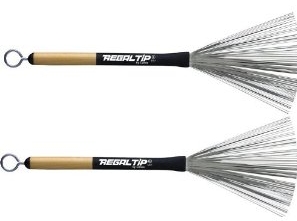

For the longest time I used fixed handle brushes, and was in love with Regal Tip's Clayton Cameron model. I grew tired of carrying them in their plastic tubes to protect the wires because those tubes take up a lot of real estate in stick bags. At first the Ed Thigpen model felt too heavy, but after prolonged playing (and switching among a few other brush brands and models) I came to appreciate the way these brushes balanced, and also the wood end at the rear of the handle opens an entire, new set of sounds when used to strike cymbals, drum rims, and even drum heads (think Joe Morello on Three To Get Ready).

While I love the Ed Thigpen model I also carry Regal Tip's BR-575-YJ Yellow Jacket retractable brushes in my stick bag.
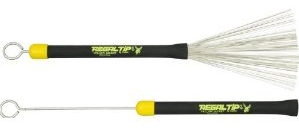

The wires flex noticeably more than most brush models I have used. In fact, the feel of the wires is similar to the feel of nylon, while still producing the distinctive sound that only a wire brush can provide. The wire is such a thin gauge that you may encounter problems with them falling out under heavy playing (I have heard a few such stories on various forums). I use mine for ballads because of the way the bristles flex. And unlike other brushes, these do not catch on new heads. They also require less break-in time.

My former favorites and still a model I love) is the Regal Tip Cameron Clayton model.
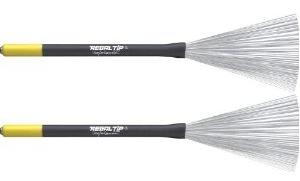

The wires seem to be the same gauge as the ones in the Regal Tip's BR-575-YJ Yellow Jacket retractable brushes Pair. They are ideally suited to ballads, and because they are slightly longer than fully extended wires in the Yellow Jacket model, you can use them for heavier playing as well. Another plus about the wires (and the overall balance of the brush itself) is they lend themselves to rim rolls.

I love the balance. Clayton Cameron came up with the basic design and it suits me perfectly. I am pretty sure the length of the handle, diameter and weight are factors. And the wires may also contribute.

The metal tips in the ends of the handles are good features. They work beautifully for getting that zing sound when dragging the end around the circumference of a cymbal using the lathed tonal grooves.

Why don't I still use them exclusively? I have grown to like the convenience of retractable handle brushes. Those do not need to be housed in a plastic tube to prevent the wires from bending and snagging. Also, I have developed the habit of adjusting the fan on my right brush - using the handle - to calibrate how legato or staccato I want to play. I can also do that with the fixed brushes using a rubber band at the top of the wires and sliding it down, but the handle is easier and quicker. I still carry a pair of these brushes in my main stick bag because there are times when it's the right brush for the music.

I have not scratched the surface of the models I plan to discuss (I still have over fifteen other ones to cover). However, those can wait until I have the time to write subsequent articles. In the next post I'll cover an additional three to five models. Until then, enjoy.

Getting Ahead Part 2

Before continuing the heads discussed in my previous post I want to recommend that you read my approach to tuning in conjunction with the discussion of heads. There is a close relationship between tuning and head choice, and since I am focusing on a relatively narrow set of head models, you may find information of more value in that piece.

While I love Remo Coated Ambassadors, I also have a love affair with their Fiberskyn series (as well as the 14" Skyntone snare drum heads.)

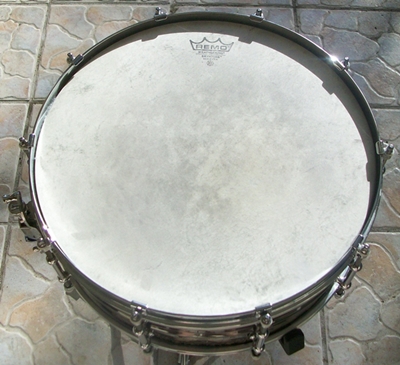
Remo started out making the Skyntone for snare drums, and I was an early adopter. My take on it is that it works beautifully with both sticks and brushes. It is thin to the point where you need to be concerned if you play mainly with sticks and are a heavy hitter. While the tone I get from these heads is superb to my ears, it's possible that they will need frequent replacement. Thus far I have had no problems with them, but I am an extremely light hitter and I play mostly between PP and F. The texture is similar to genuine calfskin, including simulated pore holes.

I have this head model on five of my snare drums, including a circa 1920s Ludwig Pioneer, a few custom made single-ply snare drums, and a Rogers Powertone COB. The head transformed each of these drums into a low-volume jazz instrument that sounds superb with brushes and very light playing. If you are a rock drummer you may find that this head will not suit your needs. Remo has since started making them in tom sizes, including 10", 12", 13", 15", and 16" sizes. Those, plus the 14"Skyntone snare drum heads, will allow you to completely out most drum kits - except for the bass drum. Frankly, I am sticking with the Fiberskyns for the time being because I am very pleased with them, and I am still a little uncertain about the durability of the Skyntones (although the ones on my snare drums have held up very well.)

Ludwig 100th Anniversary Snare Drum
Outfitted with a new 14" Skyntone snare drum head

My next most used configuration uses Remo Fiberskyn heads. I'll start with the 14" Fiberskyn FD. This is a Diplomat weight head that I prefer. This head, paired with a Diplomat snare side head on the bottom of my snare drums is a perfect combination for my playing style. However, I do not limit this head to my snare drum - I also use it as the batter side on my toms, paired usually with a Remo Renaissance Diplomat on the resonant side.

What I particularly love about this head is its ability to fit into acoustic mixes as well as in some rooms that are challenging. Most of the time those challenging rooms make other heads sound too lively, whereas the Fiberskyn seems to tame down the acoustics (with some tuning tweaks and on occasion cursing, of course). As for brush playing, there is sufficient texture to achieve legato notes on ballads, and for the staccato notes, the head sounds superb. Here is a tip: try the Vic Firth Steve Gadd model bushes on this head (and the 14"Skyntone snare drum heads as well). Ironically, that brush was designed for heads like the coated Ambassador, but works best this this and the Skyntone.

This is an excellent head choice for some situations, and works particularly well when paired with the resonant heads I mentioned. If you want even more attenuation and warmth, while retaining some resonance, the Fiberskyn FA head may be a better choice.

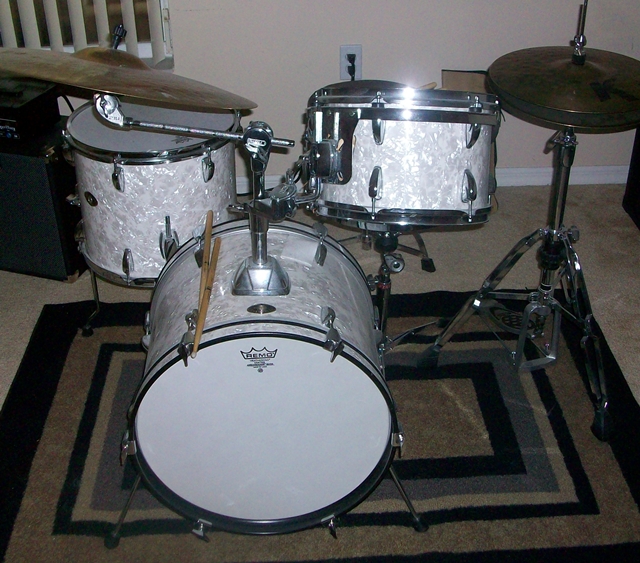
My kit with Fiberskyn heads

A word about the reso heads on the toms. I use Remo Renaissance Diplomat heads on the kit shown. Here is a shot that shows the resonant side of the rack tom:


The 12" Renaissance Diplomat shown works perfectly as a resonant head on toms with Fiberskyn FA (Ambassador) or FD (Diplomat) weight heads on top. In fact, they give noticeably more resonance than pairing Fiberskyns top and bottom. In addition, they work beautifully paired with a coated Ambassador on top. In that case, they provide a little more resonance and a slightly brighter sound.

Used as batter heads on toms they are a bit too bright and thin sounding, but warmer than clear heads. Paired top and bottom, they are still too thin for my tastes, but I have to admit that they have a nice tuning range and feel. The same goes for the 14" or any other size of this head.

The bass drum heads I use are interesting in that I stumbled upon the combination by accident. The batter head is a Remo Powerstroke 3 Fiberskyn. When I purchased this it was a compromise. I normally will not use pre-muffled heads, but could not get an Ambassador weight unmuffled head at the time because they were back ordered.

I opted for a Diplomat weight to offset the muffling, which is nothing more than a plastic ring on the backside of the head. To further offset the muffling, I opted to not use my tried and true approach: Gibraltar SC-BF Bass Drum Felt Strips. My last ploy was to use a non-Powerstroke 3 Fiberskyn Diplomat for the resonant side (without felt strips.)

The combination worked perfectly. Frankly it exceeded my expectations and when I was able to obtain the Ambassador weight, unmuffled heads I wanted in the first place they did not come close to matching the warmth and depth this head and the companion reso provide. Sometimes one does get lucky.

My concern that the Diplomat weight would not hold under live playing was assuaged by the fact that I actually used this kit as backline in a jam and the head held up fine. So much for stories of coating loss and short lifespan.

Needless to say, the serendipitous events that led me to purchasing this head against my better judgement (at the time) worked in my favor. If I outfit another of my kits with Fiberskyns, this is the combination I will use.

My next topic will be a follow-up on brushes. Until then, enjoy.

Thursday, May 24, 2012

Getting Ahead Part 1

OK, poor pun. Heads are more important to your sound than we tend to give them credit for. I did touch on heads in a post I wrote over two years ago, Selecting Heads and Brushes for Brush Playing, and a companion post titled A few heads I left out and words about the best snare drum for brushes. Those, however, were pretty specific in focus.

Before proceeding, here are a few caveats:

  • I play a narrow set of genres - mainly jazz and blues
  • My preferred sound is open and minimally muffled
  • The only heads I am going to discuss are ones with which I've had direct and extensive experience
The bottom line is there are a lot more brands and models than I a going to discuss, and it's more than probable that some of those that I do not discuss may be a better match for your playing style, music and personal sound. One size does not fit all.

First up is my workhorse heads - Remo Coated Ambassadors.

I use these on everything - snare batters, and tom and bass drum batters and resonants. Let's start with why I love them on snare drums: For snare drum batter heads I have tried every other head on the market and the Remo coated Ambassador has the resonance, warmth and for snare drums, the right texture, that I want in a drum head. Bear in mind that I play a lot of acoustic jazz and like my drums to be open sounding. Also, I have found that when paired with a hazy Diplomat on the snare side I get superb response.

Regarding the texture - there are certain Aquarian models that have better texture for brush playing, but sound too plastic like with sticks. My solution is to take some 400 grit sand paper and lightly (very lightly) pass over the surface. This smooths the rough spots without starting a wear spot that will prematurely shorten the head's life. Note: This head will not fit some vintage drums, which I will address further on, and also will not fit Premier drums in metric sizes. Remo has a model especially for those: BA-0114-PR. In fact, if you replace the "00" with a "PR" in Remo part numbers you will get the model number for heads that fit the metric sized Premiers.

Since I play mostly 20" bass drum, 12" and 14" toms or the same configuration with 18" bass drums, I also use 12" coated Ambassadors for my rack toms (the 14" snare head works on my floor tom) and either the 18" coated Ambassador or the 20" model on my bass drums.

Like my toms, I use the heads on both the batter and resonant sides. For me this configuration is not only excellent for old school blues, but perfect for jazz. I do not stuff anything into the bass drum, and, in fact, usually use a single felt strip (depending on the room.) The resonance and warmth this head provides is amazing. On every bass drum, from the lower end Tama and Gretsch, to my custom made one, this head emits a note instead of a thud. Of course, my muffling and tuning approaches have a lot to do with that, but still, this is a sound that you are not going to get from pre-muffled heads, or even film batters and resos.

A few shots of one of my kits
The Snare drum is a very unique one that was custom made using 1930s Radio King parts and a magnesium shell. The engraved hoops required Aquarian American Vintage heads

Remo also sells convenient prepacks of these heads in various configurations: 10, 12, 14 and 14 (for the snare drum), as well as a 12, 13, and 16 pack for toms but no snare drum.

Before continuing with modern heads I want to address the snare drum head shown in the photo above because if you have vintage drums this one is important. The head brand and model are Aquarian American Vintage (not shown is the snare-side companion.This head was designed specifically to fit vintage American snare drums. The reason I am emphasizing 'American' is because other vintage drums, like Premiers, may use metric sizes in which case this head will not work.

The reason this head is needed is because circa 1900s-1930s and even later snare drums were made slightly oversized by today's sizing standards. For example, the vintage 14" diameter drums were really 14" whereas modern snare drums cited as 14" are really 13.85. To confuse the issue, the above applies mostly to wood snare drums. In my experience, modern heads seem to fit most metal snare drums from the same vintage eras. Still, I am citing rules of thumb and not hard and fast facts because there are always going to be exceptions.

Also note that some late 1800s through early 1900s snare drums - regardless of material - were such off sizes that your only recourse is to have custom heads made for them. Measure first before ordering!

There is a lot to like about this head. The slightly yellowed vintage surface is a nice touch. The texture is beautiful for brushwork. And, of course, the fact that it allows you to play a vintage snare drum that would otherwise be sitting in a display because of heads is the best thing to like. However, to my ears this head has a plastic-like sound when played with sticks. Bear in mind that is the way I personally hear it, and you may not have the same impression. Also, in a live playing situation that sound disappears into the mix.

Aquarian did the vintage drum world a great service with this series because prior to these your only option was to have heads custom made. Or display the snare drum in a case. The first option was expensive (breathtakingly so, in fact), and the second option was a waste of an instrument that survived through the years and deserved to be heard. Aquarian makes a full range of sizes in this series, so if you are outfitting an entire drum kit you may find this to be the best solution.

In my next post I will cover the other heads I use, which are the Fiberskyn series I have on some of my snare drums and one of my drum kits, and the Remo Skyntone, which I have started using on my snare drums.

Tuesday, May 22, 2012

Stick bags - function and vanity

Every so often stick bags come up as a topic. Most drummers I run across usually have some sort of canvas bag, with the cheaper ones like the Zildjian, Meinl and similar bags being the most common. Going up the food chain a notch you sometimes see drummers carrying something along the lines of the Kaces Not Leather Deluxe Stick Bag. The truth be known, the low end bags are functional and truly serve most drummers well. They lack the cool factor, however. I am going to devote this entry to bags that are cool.

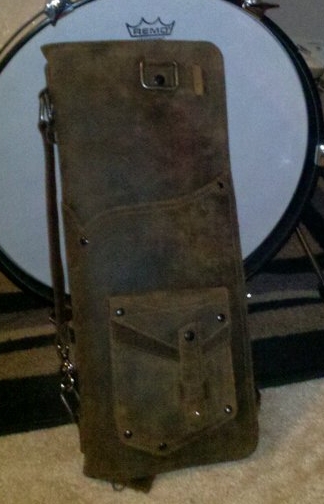
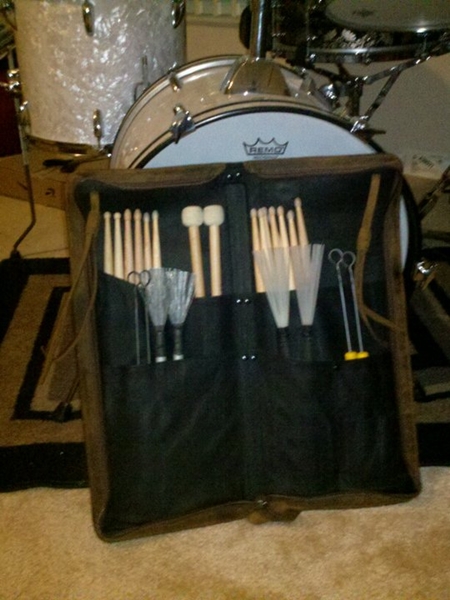
At the top of the food chain, in my opinion, is the Anthology Gear Wear stick bag. I own one, shown in the following photos:

Front (shown leaning against an 18x14 bass drum)

Rear

Open

Note the size (pretty large), capacity (considerable) and looks (uber cool). Although this bag has rawhide straps to hang it from a floor tom, it is so heavy and dense that it would kill the drum's resonance. Also note that the pockets are not nylon like most other high end bags, but, instead, are leather.

This is truly the epitome of stick bags. Also, if you do not like the finish, called "black whiskey" you can have one made in carbon black instead. There is ample pouch space - shown in the front and back shots - plus a pocket for music or other papers. And the carrying strap will make guitar and bass players drool.

The only other bag I have come across that has anything near the capacity is the Peter Erskine Stick Bag (formerly made by Yamaha and now by DW.)

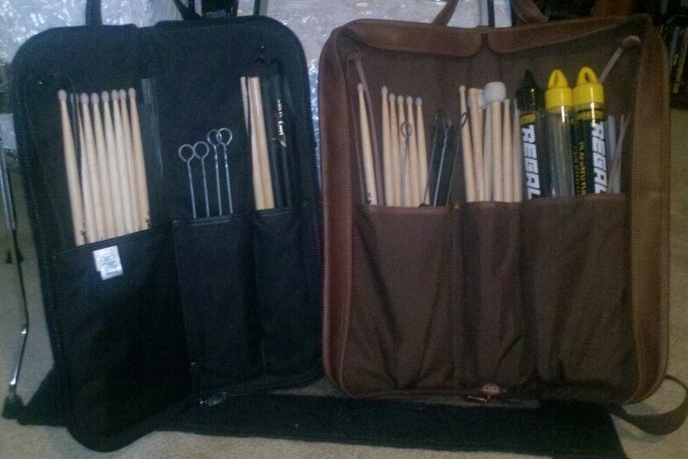
The next bag down on the food chain of high-end bags and the brand that most folks associate with the pinnacle of stick bags is the Reunion Blues brand. I have both the large model (in black leather) and the extra large model (in chestnut leather). Here are the two, side-by-side, for comparison:

Closed (leaning against a 20x14 bass drum)

Open

I have to admit that the extra large model does not get as much use as the smaller 'large' one, which is more than sufficient for my needs.

That is not to say that the extra large bag is not best for some drummers. For touring drummers that model will easily carry a more than adequate supply of sticks, mallets and brushes. For percussionists who use a wider array of stick and mallet types this bag is hands-down the best.

Another point in extra large bag's favor over the smaller one is if you play with fixed brushes such as the RegalTip Clayton Cameron model, then this bag will easily hold the plastic tubes you probably store those brushes in (the smaller bag cannot do that.)

On both bag models the front pouch can hold an array of drum keys, small tools and spare parts with room to spare.

Both are also built to last a lifetime, with careful attention paid to zippers and stitching. The leather is of the highest quality and it looks as good as it is constructed. If you are a professional drummer or percussionist this bag is an investment.

Back to the Peter Erskine Stick Bag. If you want to set vanity aside and go for pure function, this is the bag to get. It is not sexy like any of the above bags, but will hold just about anything you need, and is well constructed. I had the Yamaha model and loved it. Unfortunately, I got bit by the vanity bug and sold it, whicb I sometimes regret.

I also own a few other vanity type stick bags that I rarely use and, frankly, find to be of questionable value. One is the Levy's Leathers Suede Stick Bag, and the other - also by Levy's Leathers - is the Levy's Leathers LM9-BRN Stick Bag. Read my reviews on each page to see why I am not as enthusiastic about those models.

For high end bags I have to confess that I am hooked on the Anthology Gear Wear stick bag. And, make no mistake, it's because of the vanity factor because it is a very heavy bag and holds more sticks, brushes and mallets than I would ever use in a single gig. On the other hand, I have fallen in love with my Reunion Blues large, black leather stick bag. It holds the perfect number of sticks and brushes that I routinely use, and looks great. I love the carrying strap and its light weight.

However, there is nothing whatsoever wrong with the lower-end bags. We are, after all, protecting implements that we bang against surfaces, so any cost/benefit arguments are contrived at best. But you cannot put a price tag on cool, right?